Abstract
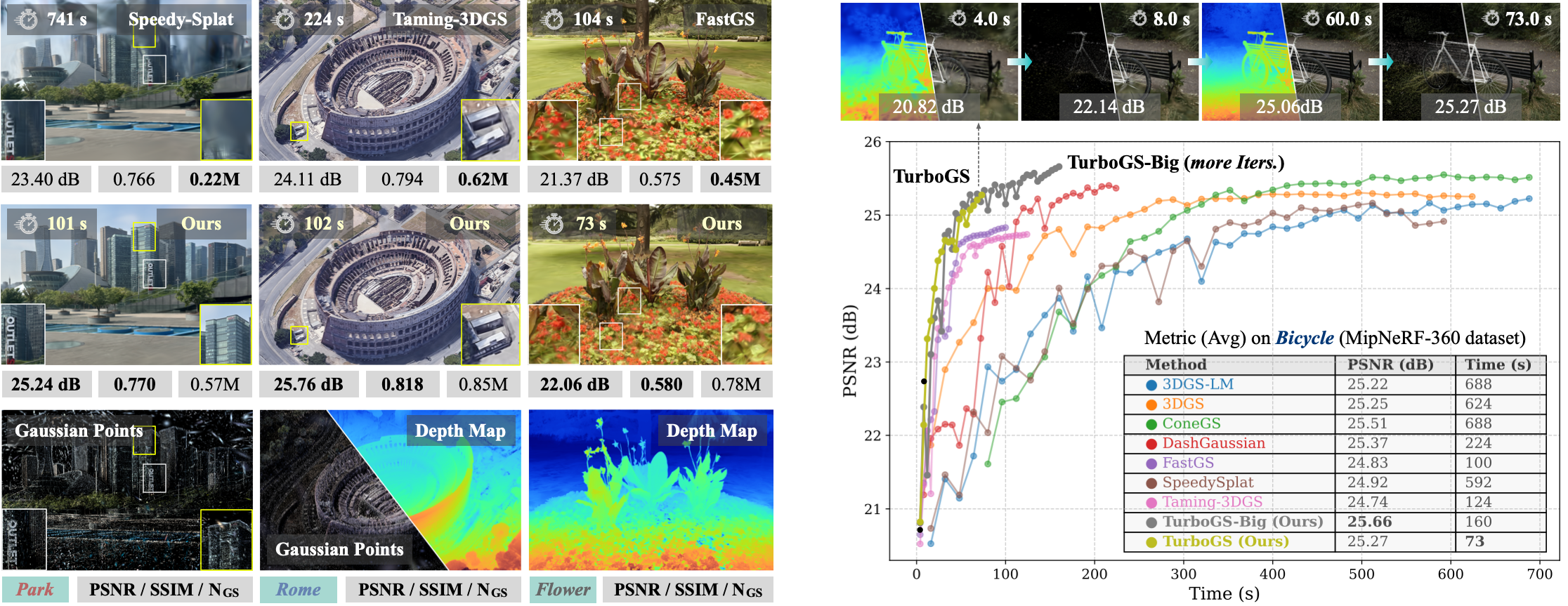
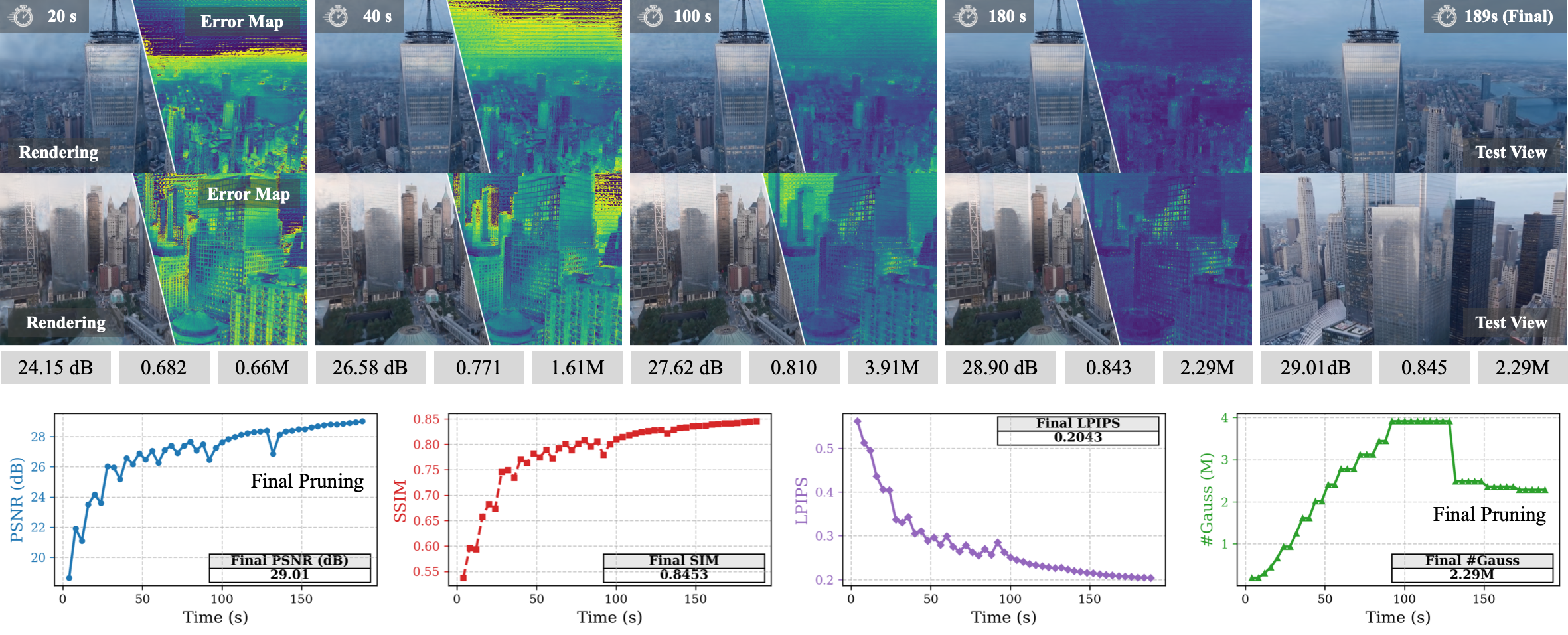
TL;DR : We propose TurboGS, a novel framework that accelerates 3DGS optimization while delivering high-quality novel view rendering across scene scales. By introducing error-guided sparse-pixel optimization and Gaussian density control, TurboGS converges faster to better results within ~100s.
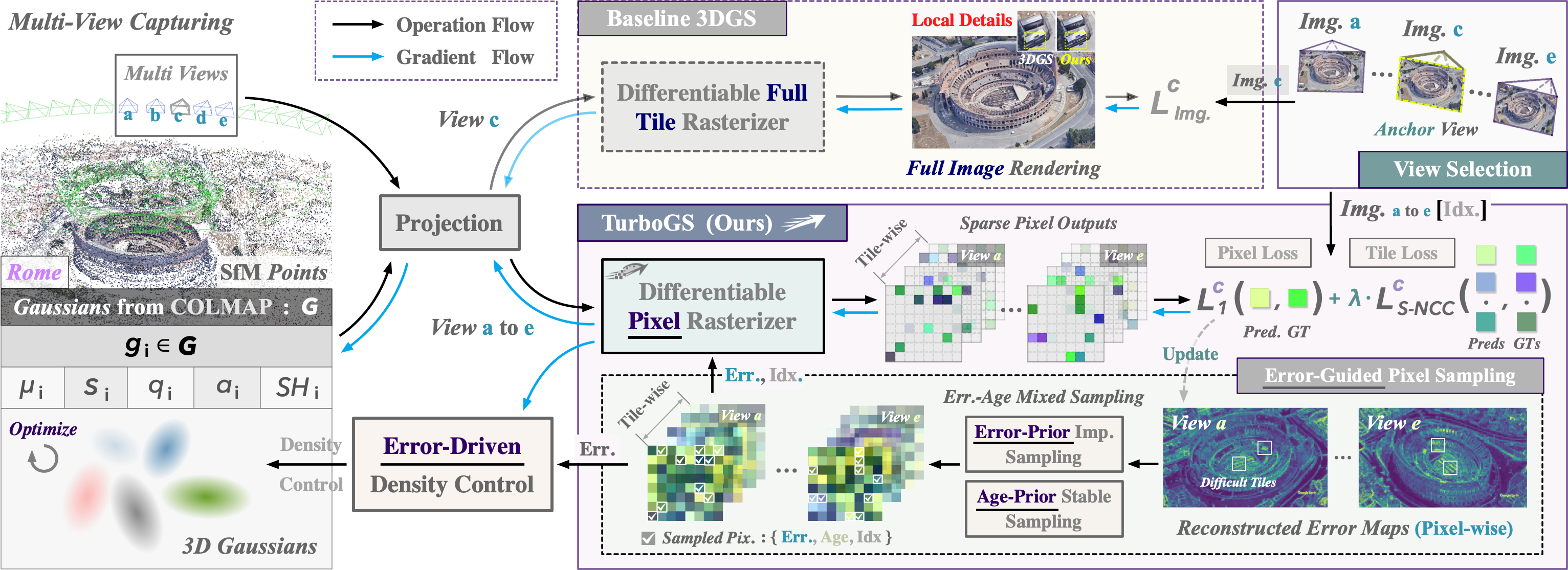
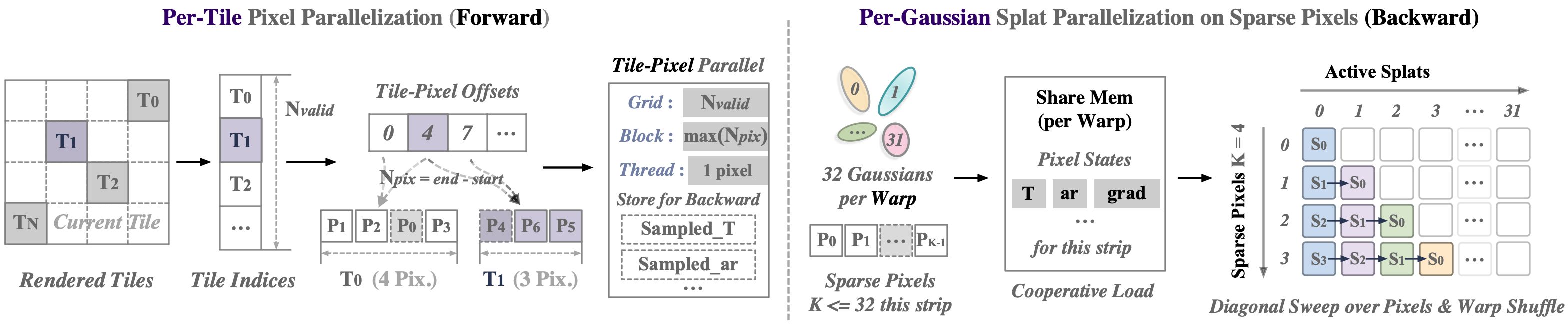
Consumer-level applications require fast optimization of 3D Gaussian Splatting (3DGS) with high-fidelity novel view rendering. However, existing 3DGS acceleration approaches still incur substantial computation on redundant pixels while sacrificing fine details. In this paper, we present TurboGS, an error-guided training framework that accelerates 3DGS by concentrating optimization on perceptually informative pixels. TurboGS is built upon four core components: (1) a tile-wise sparse pixel sampling, which, driven by multi-view reconstruction errors during training, prioritizes challenging regions and skips well-reconstructed ones to avoid redundant gradient computation; (2) a tile-wise structure-aware loss with sparse Normalized Cross-Correlation, which provides sparse yet effective supervision to preserve fine details and stabilize training; (3) an error-driven Gaussian density control strategy, which dynamically allocates model capacity and removes redundant primitives; and (4) a tailored hybrid optimizer that couples Hessian-informed updates with Adam moment damping to stabilize and improve convergence under sparse supervision. Experiments on standard benchmarks demonstrate that TurboGS can deliver on par or superior rendering quality within 100 seconds on a single RTX 5090 GPU card (up to ∼10× training speedup over vanilla 3DGS).